
White noise for babies: is it OK, how loud and how far away
A hiss, the sound of rain or a fan often settles a baby better than a lullaby, and many parents keep white noise on their phone or buy a separate machine. We look at what research says about it, which volume does not harm hearing and where the machine should stand so that sleep stays safe.
Contents 10 sections
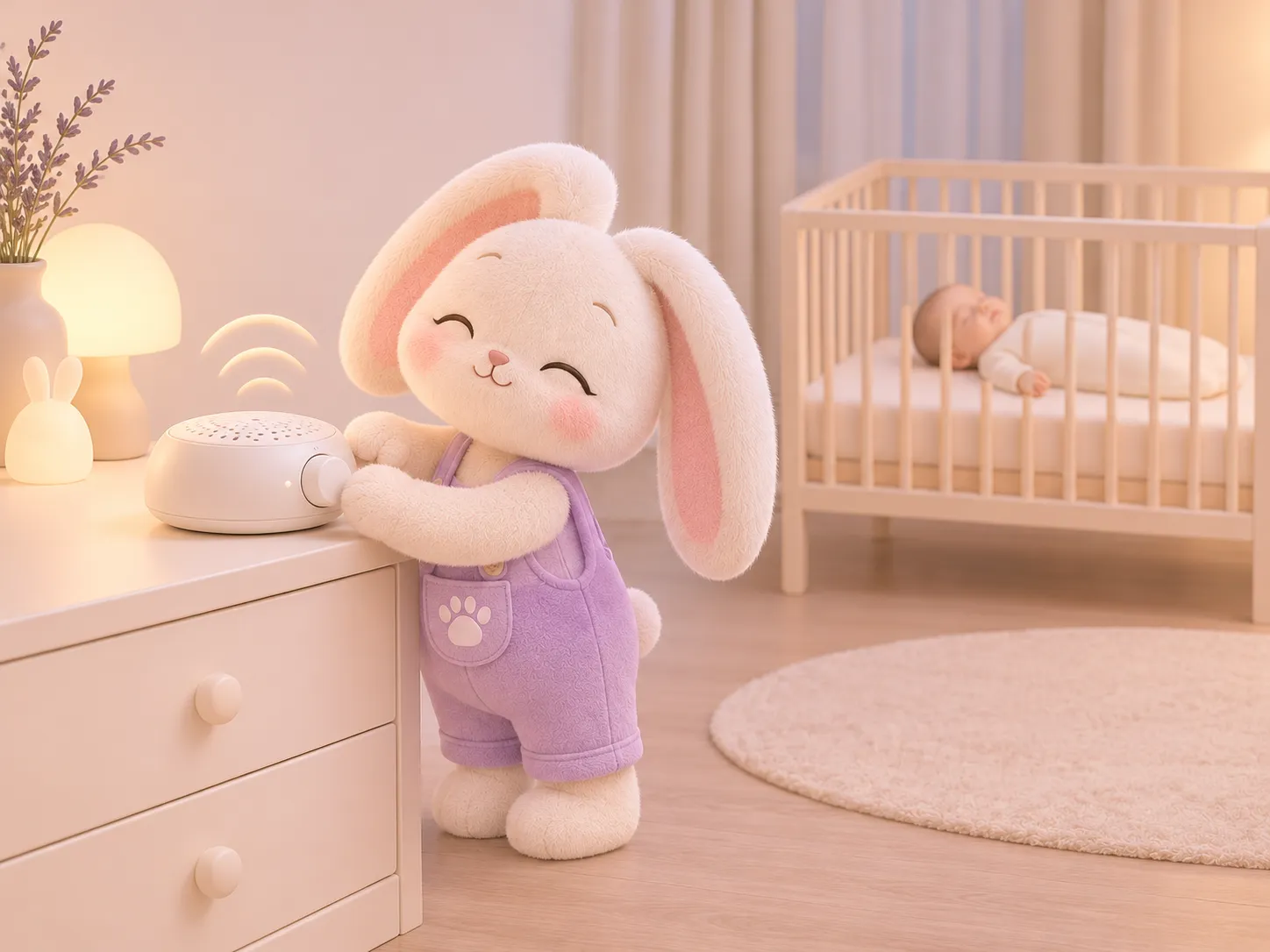
White noise may help some babies fall asleep faster, but the evidence is still thin. What matters is volume and distance: in a 2014 study all 14 machines at full volume were louder than 50 dB, the level seen as the limit for hospital newborn nurseries. Put the machine not in the cot but as far from it as you can, ideally 2 m away, use the quietest level that works, and let a timer switch it off once the baby is soundly asleep. White noise does not replace the safe sleep rules.
What white noise is and why it soothes
White noise is a steady sound without a tune in which all frequencies play at once: the hiss of a radio between stations, the hum of a fan, rain or running water. Parents often just call it «shhh».
Inside mum it was far from quiet: for nine months the baby heard the heartbeat, blood flow and voice. A steady noise is reminiscent of those sounds, and it also muffles sharp everyday ones: a door banging, a dog next door, a car outside. That is why some babies settle more easily with it.
Does it really help: what research says
The study cited most often is a small British one from 1990. Forty newborns aged 2-7 days were split into two groups. With white noise 16 of 20 babies fell asleep within 5 minutes, without it 5 of 20.
The result is encouraging, but the study is small. In 2021 American researchers reviewed 38 papers on noise as a sleep aid, mostly in adults, and rated the quality of the evidence as very low.
Red Nose, the Australian safe sleep organisation, says there are no known risks of white noise and the limited data suggest it may help some babies. But a hungry or cold baby will not fall asleep even with noise: deal with the cause first, then the soothing sounds.
Which volume is safe for hearing
The key study here came out in 2014 in the journal Pediatrics. Canadian doctors tested 14 infant sleep machines at full volume. They measured at 30, 100 and 200 cm, adjusted for the ear of a six-month-old.
- At 30 cm, that is by the cot side, all 14 machines were louder than 50 dB. The authors name 50 dB as the recommended limit for hospital newborn nurseries.
- Three machines went above 85 dB. Listening to that for more than 8 hours is more than adults are allowed at work.
- The average maximum volume was 79 dB by the cot, 71 dB at one metre and 63 dB at 2 metres.
For comparison, the WHO advises an average night-time noise of about 30 dB in a bedroom.
To be fair, there is another side: the researchers measured only the maximum volume, not how the machines are used at home. Whether they harm babies' hearing in practice is not yet known. So the rule is simple: the quietest level that works. You can check it with a free sound meter app on your phone: by the baby's head it should be no more than 50 dB.
Where to put the machine and how far away
- Never in the cot or on its side. The authors of the 2014 study advise putting the machine as far from the baby as possible. Red Nose's chief midwife gives a guide: outside the cot, ideally 2 m away.
- Keep cables away. The AAP asks that no cords or cables hang near the cot, and The Lullaby Trust advises keeping electronics out of the baby's reach. Once a baby starts rolling and reaching, a cable nearby becomes dangerous.
- The cot stays empty. No soft toys with a speaker hung on the side: only the baby on a firm mattress.
How long to run it
The study's authors advise running the noise briefly, until the baby is soundly asleep. It helps if the machine switches itself off on a timer after 20-30 minutes.
If your baby wakes as soon as the noise stops and you decide to leave it on all night, keep the volume at its lowest and the machine far away all the more. Eight hours of even moderate noise by the ear is a much bigger load than a few minutes.
White noise does not replace safe sleep
Noise helps a baby fall asleep, but it does not make sleep safer. The risk of sudden infant death syndrome (SIDS) is lowered by other things: back sleeping, a firm empty cot, the parents' room and a cool 16-20 °C. We gathered all of it in our article on safe sleep for babies.
Make sure the noise does not drown out the baby too: you need to hear when they cry or cough. The NHS, by the way, advises not aiming for total silence in the daytime: it is good for a baby to get used to ordinary household sounds.
Warmth at night comes from clothes and a sleeping bag, not a blanket. We explain how to choose one for the room temperature in our article on sleeping bags and TOG, and for the first weeks in the one on a cocoon for a newborn.
Machine or phone: how to choose
A separate machine is not a must: an app on your phone or an ordinary fan will do. What matters either way:
- the volume adjusts smoothly and goes down to very quiet;
- there is a timer that switches the sound off;
- there is no bright light, or it switches off separately;
- the machine stands steadily on a shelf or chest of drawers instead of hanging on the cot;
- put the phone far from the cot in airplane mode so a call or notification does not wake the baby.
Set the sound for the baby, not for yourself: a noise you can barely hear seems too quiet to an adult, but it is often just enough to fall asleep to.
How to wean off white noise
Red Nose warns that babies can get used to noise and then find it harder to fall asleep without it. There is no need to stop abruptly. Turn the volume down a step every few days, shorten the timer, and in the daytime let the baby fall asleep to ordinary household sounds more often.
For many children noise helps only in the first months and then stops being needed on its own.
Questions and answers
Is white noise harmful for a baby?
There are no known risks if it is quiet and the machine is far away. The risk to hearing comes from loud sound close to the ear: in a 2014 study all 14 machines at full volume by the cot were louder than 50 dB.
What white noise volume is safe for a baby?
No more than 50 dB by the baby's head: that is the limit set for hospital newborn nurseries. Check it with a sound meter app and use the quietest level that works.
How far from the cot should a white noise machine be?
As far as you can, ideally 2 m away. Never put the machine in the cot or clip it to the side.
Can white noise be left on all night?
Better not: researchers advise switching it off once the baby is soundly asleep. If you do leave it on, keep the volume at its lowest and the machine far away.
Does white noise really help babies sleep?
Some babies, yes. In a 1990 study 16 of 20 newborns fell asleep within 5 minutes with white noise, and 5 of 20 without it. But overall the evidence is thin.
From what age can white noise be used?
From the first days, if the sound is quiet and the machine is far away. That same study was done with babies 2-7 days old.
Which is better: a dedicated machine or a phone?
Either works. What matters is smooth volume control, a timer and distance. Put the phone far from the cot in airplane mode.
Do babies get used to white noise?
They can. Wean off it gradually: every few days turn the volume down and shorten the timer.
Does white noise lower the risk of SIDS?
No, there is no evidence of that. The risk is lowered by back sleeping, an empty cot, the parents' room and a cool 16-20 °C.
Should the house be completely quiet while the baby sleeps?
No. The NHS advises not to worry about ordinary household sounds in the daytime: it is good for a baby to get used to them.
Sources
- Hugh S. C. et al. Infant Sleep Machines and Hazardous Sound Pressures. Pediatrics (2014)
- NEJM Journal Watch: Sleep Machines May Damage Infant Hearing (2014)
- Spencer J. A. et al. White noise and sleep induction. Archives of Disease in Childhood (1990)
- Riedy S. M. et al. Noise as a sleep aid: A systematic review. Sleep Medicine Reviews (2021)
- Red Nose: Can white noise help settle your baby?
- NHS: Helping your baby to sleep
- ErgoPouch: What is white noise? (comment of Red Nose Chief Midwife Jane Wiggill)
- The Lullaby Trust: Baby sleeping products
- The Lullaby Trust: Baby monitors
- HealthyChildren.org (AAP): Make Baby's Room Safe
- WHO Guidelines for Community Noise: guideline values (table reproduced by Quality Planning, New Zealand)
- NIOSH (CDC): About Noise and Occupational Hearing Loss