Bathing a Newborn: When to Start, How Often, and How to Bathe Safely
The first bath at home scares almost every parent: your baby is tiny and slippery, and the advice is endless. In fact, there are only a few rules. We cover when to start, how to manage with sponge baths until the cord heals, how to prepare the water, and what never to do.
Contents 10 sections
Until the umbilical cord stump falls off, usually in the first one or two weeks, your baby is not bathed in a tub but sponge-bathed with warm water. After that, two or three baths a week are enough, with the face, neck, hands and diaper area washed every day. Fill the tub with 8-10 cm of water as warm as the body: check it with your elbow. For the first month, use plain water, with no soap or oils. Never leave your baby in the water even for a second, and do not use bath seats.
Bathing a Newborn Checklist
One A4 sheet with tick boxes: print it or save it on your phone and check off what is ready.
When to give the first bath
The WHO advises delaying the first bath for at least 24 hours after birth, so in the maternity hospital babies are usually only wiped clean, not bathed. At home, there is no rush to get out the tub either.
The American Academy of Pediatrics (AAP) advises only sponge baths, without putting your baby in water, until the umbilical cord stump falls off. It usually falls off within one or two weeks. Keep the stump dry and put nothing on it: the WHO notes specifically that ointments are not needed. If it oozes, turns red or smells unpleasant, show it to your pediatrician.
Once the cord area has healed, you can move on to the tub. The AAP advises keeping the first baths brief and very gentle: your baby is only getting used to the water.
How often to bathe
You do not have to bathe a newborn every day. The NHS says two or three times a week is enough, and the AAP considers three baths a week enough for the whole first year. Frequent bathing dries out delicate skin.
If both you and your baby enjoy bath time, daily is fine: the NHS allows it. Then it becomes part of the bedtime routine we describe in our article on safe sleep.
On days without a bath, wash your baby after each diaper change and wipe the face, neck and hands, where milk and dust collect.
Sponge baths: until the cord heals and between baths
A sponge bath takes a few minutes and needs no tub. The NHS advises:
- Two bowls of warm water: one for the face, the other for the bottom.
- Eyes are wiped with a cotton pad dipped in the water, from the nose outward, using a fresh pad for each eye.
- Face, neck, outer ears and hands are wiped with a damp pad, especially the creases of the neck, where milk hides.
- The diaper area is washed with water from the second bowl, front to back for girls.
- Pat dry with a soft towel rather than rubbing.
To keep your baby from getting cold, undress one part at a time: the rest of the body stays wrapped in a towel or a muslin swaddle.
How to get ready for bath time
Half of a calm bath is preparation. Everything you need should be within reach before your baby is in the water, because you cannot step away from the tub after that.
- A warm room. The NHS reminds us that babies get cold quickly.
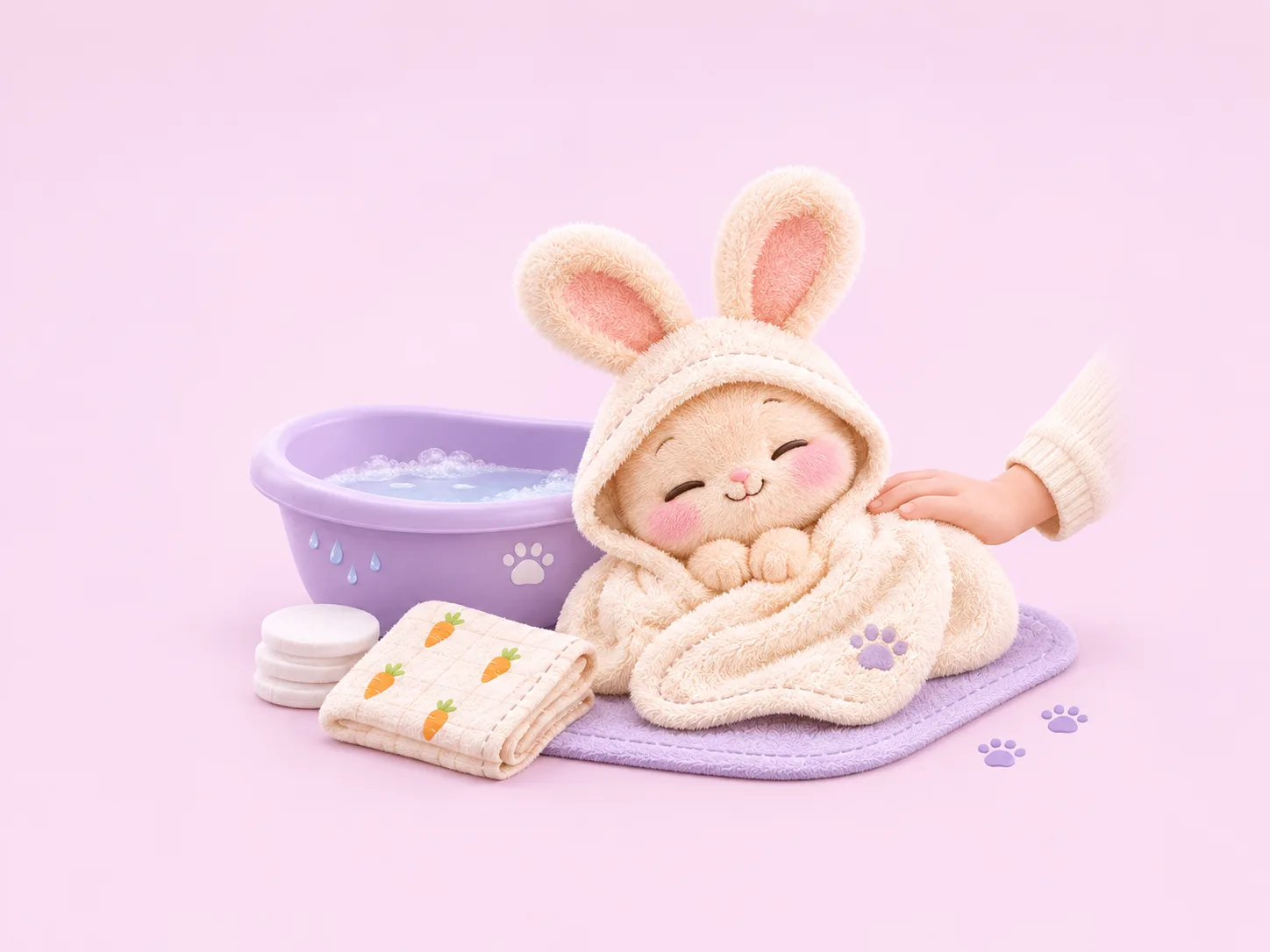
- Within reach: a hooded towel, a clean diaper, a bodysuit and a sleepsuit, cotton pads.
- Not straight after a feed, and not when your baby is hungry or tired, as the NHS advises.
- Cold water first, then hot. Mix the water well so there are no hot patches.
- Not much water: the NHS advises 8-10 cm.
- Body temperature. The NHS checks it with the elbow: the water should feel neither warmer nor cooler than your skin. With a bath thermometer, that is about 37 °C.
The AAP advises setting your water heater so the tap water is no hotter than 49 °C. If your water heater can be adjusted, this protects against scalds when someone turns on the hot tap by accident.
How to bathe your baby: step by step
- Face first. Holding your baby on your knee, still in the towel, wipe the face and eyes as for a sponge bath.
- Head over the tub. Wash the hair with plain water, supporting your baby over the tub, and pat it dry right away.
- Into the water slowly. Support the head and shoulders with one hand and lower your baby into the water feet first with the other.
- A hand on your baby at all times. That is the AAP's advice. To keep your baby warm, pour warm water from your palm over the chest and tummy.
- Keep it short. The first baths last a few minutes. As soon as your baby starts to get cold or cry, it is time to come out.
Soap is not needed in the first month: the NHS says plain water is best for a newborn's skin. Later, the AAP advises a mild, pH-neutral cleanser without additives, just a little, rinsed off right away.
Safety: what never to do
- Never leave your baby in the water, even for a second. Both the NHS and the AAP say so. If the doorbell or phone rings, wrap your baby in a towel and take them with you.
- Do not use bath seats or bath chairs. The AAP warns that they tip over easily and a child can fall into the water. According to the AAP, most child drownings at home happen in the bathtub.
- Do not leave bath time to older children, and do not get distracted by your phone.
- Do not fill the tub too high. For a newborn, 8-10 cm is enough.
For the first months, the AAP recommends a hard plastic infant tub or a clean sink rather than the big bathtub.
After the bath
Wrap your baby in a hooded towel straight away: the head is wet, and that is where warmth escapes fastest. Our Bunny Ears Hooded Towel is 90×90 cm terry cloth with a bunny-ear hood, and it will last for several years.
- Pat the creases dry: the neck, armpits, behind the knees, between the fingers and toes. The NHS makes a point of mentioning skin creases.
- The cord area, if it has not fully healed yet, should be patted dry.
- Oils and lotions are best avoided until at least one month, the NHS advises. If the skin is dry, your pediatrician will suggest what to use.
- Dress your baby in a diaper, a bodysuit and a sleepsuit. We explain which size to choose in our article on sizes.
After the bath, many babies feed and fall asleep. Lay your baby on their back, in a sleeping bag suited to the season, without a hat.
Checklist before bath time
- Cord area healed, otherwise sponge baths only
- The room is warm
- Towel, diaper, clothes and cotton pads within reach
- Baby has not just fed and is not hungry
- Cold water first, then hot, mixed well
- 8-10 cm of water, body temperature, checked with your elbow
- No soap or bubble bath in the first month
- A hand on your baby at all times, phone put away
- After the bath, pat the creases dry and dress your baby
We list the bath things you will need in the first weeks in our article on the hospital bag.
This article explains general recommendations and does not replace advice from your pediatrician. If your baby was born early, has skin problems, or the cord area is slow to heal, ask your doctor how and when to bathe your baby.
Questions and answers
Can I bathe my baby before the cord stump falls off?
Not in a tub. The AAP advises only sponge baths with warm water until then, keeping the stump dry. It usually falls off within one or two weeks.
What water temperature do I need to bathe a newborn?
Body temperature, about 37 °C. The NHS advises checking with your elbow: the water should feel neither warmer nor cooler than your skin. Run the cold water first, then the hot, and mix well.
How often should I bathe a newborn?
Two or three times a week is enough, according to the NHS and the AAP. Daily is fine too if your baby enjoys it, but wash the face, neck, hands and diaper area every day.
Do I need soap, bubble bath or herbs in the water?
Not in the first month: the NHS says plain water is best for a newborn's skin. Later you can use a little mild, pH-neutral cleanser and rinse it off right away.
Can I use a bath seat?
The AAP advises against it: a bath seat tips over easily, and your baby can end up under the water. Use an infant tub and keep a hand on your baby the whole time.