A Winter Snowsuit for Your Child: How to Choose One and Which Size to Buy
A winter snowsuit is bought for a whole season, sometimes two, so getting the size or filling wrong is costly. Here is which snowsuit suits a baby in a stroller and which suits a child who runs in the snow, how to read the label and how to try it on so it is neither tight nor too big.
Contents 9 sections
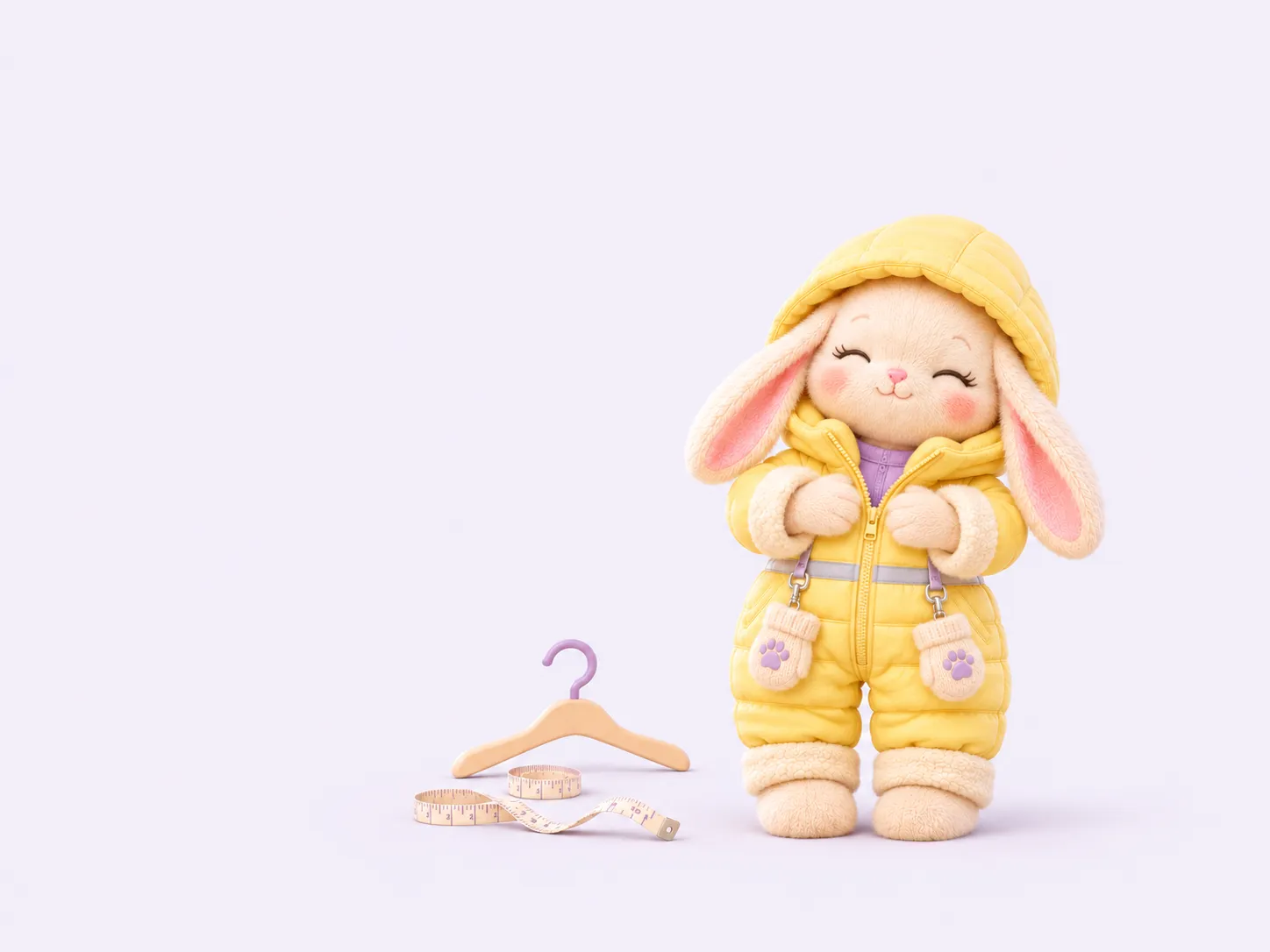
A snowsuit size, like other children's clothing sizes, is the child's height in centimetres. Choose the size that matches the height or is a little bigger, but not two sizes ahead: a snowsuit that is too big is colder and awkward to move in. A baby in a stroller does well in a one-piece or convertible snowsuit; a child who walks and plays in the snow, in a two-piece or a one-piece with a membrane. Try it on over the clothes your child will wear outside.
Checklist: trying on a snowsuit
One A4 sheet with tick boxes: print it or save it on your phone and check off what is ready.
One-piece, convertible or two-piece
Winter snowsuits come in three kinds, and each suits its own age.
- A one-piece snowsuit with a hood, often with closed feet and fold-over mittens. No cold gets in anywhere, so it is the best choice for a baby who does not walk yet and for a child up to two or three.
- A convertible unzips into a bunting bag or turns from a bunting bag into a snowsuit with legs. Handy for the first year: at first your baby lies in the stroller, later sits up.
- A two-piece, meaning a jacket and salopettes with braces. It suits children who run about a lot, and nursery: it is easier for a child to dress on their own and go to the toilet, and the jacket can be worn separately.
For a baby in a stroller, both a snowsuit and a bunting bag work. We explain how they differ on a walk in our article on dressing a baby in winter.
Which size to buy
The number on the label is the child's height: 68, 74, 80, 86 and up in steps of six centimetres. More on this in our article on sizes. A snowsuit has two special points.
- It goes over several layers. So if your child's height is near the top of a size, take the next one.
- It is bought for the whole season. Over a winter a baby under one grows several centimetres, so one size of room makes sense. Two sizes ahead does not: a snowsuit that is too big leaves a lot of air between the body and the fabric, the child is colder, the sleeves cover the hands and the hood slips over the eyes.
Many snowsuits have turn-back cuffs on the sleeves and legs. You fold them up at the start of the season and let them down as your child grows. The label of such a snowsuit sometimes shows two sizes, for example 74/80.
Filling: down, synthetic or wool
- Down is the warmest for its weight and packs down well. But it dislikes moisture and needs careful washing so it does not clump.
- Synthetic filling (such as hollowfibre or Thinsulate) washes easily, dries quickly and stays warm even when slightly damp. For everyday walks and nursery it is the most practical choice.
- Wool comes as a lining or a separate layer. It holds warmth and lets moisture out, but some children find it itchy, so a cotton layer goes underneath.
Synthetic snowsuits state the amount of filling in grams per square metre. Sellers usually suggest about 100-150 g for spring and autumn and 200-300 g for winter. Remember that a baby in a stroller barely moves and gets cold faster, while a child who runs about will soon sweat in a very warm snowsuit.
Outer fabric and membrane
The outer fabric of a winter snowsuit is a dense cloth with a water-repellent finish. For a baby in a stroller that is enough. A child who sits in the snow and climbs slides is better off with a membrane: the fabric keeps water out but lets moisture from the body escape.
A membrane label shows two numbers:
- Waterproofing in millimetres, for example 5000 mm. The higher the number, the longer the fabric stays dry.
- Breathability in grams per square metre per day, for example 5000 g/m². The higher the number, the less the child sweats.
A membrane works only when the clothes underneath also let moisture through. So wear thermal underwear or fleece under it, not a thick cotton jumper that soaks up sweat and takes long to dry.
Small details that matter
- A hood without drawstrings. The Canadian Paediatric Society advises removing drawstrings from children's clothing: they can catch on a slide or play equipment.
- A flap under the chin, so the zip does not rub or pinch the skin.
- Removable fur trim on the hood. It is easier to wash and does not get in your child's face.
- Reflective details. It gets dark early in winter, and drivers can hardly see a child in a dark snowsuit.
- Mittens on clips, not on a string around the neck, as Canadian paediatricians advise.
And the main thing about the car. A bulky snowsuit under car seat straps is dangerous: in a crash the filling compresses, the straps go slack and the child can slip out. The AAP advises buckling your child in thin clothes and putting the snowsuit or a blanket on top, over the fastened straps. The check is simple: if you can pinch a fold of the strap at the shoulder, it is too loose. More on this in our article on going-home bunting bags.
How to try on a snowsuit
Try the snowsuit on over the clothes your child will wear outside: a bodysuit, a sleepsuit or thermal underwear and a warm top. Then ask your child to squat, raise their arms and bend over; a baby you simply sit up.
- The sleeves do not ride above the wrist when the arms are raised.
- The back stays covered when the child bends over.
- The crotch neither hangs to the knees nor pulls when the child squats.
- A flat hand fits between the snowsuit and the body, but no more.
- The hood does not slip over the eyes or cover the face from the side.
- The zip closes easily over all the layers.
Washing and care
The label is always the safest guide. A few general tips:
- Before washing, close the zips and Velcro and remove the fur trim.
- Wash a membrane with liquid detergent and no fabric softener: softener clogs the pores of the fabric and it stops breathing.
- Wash a down snowsuit at a low temperature and tumble dry it with tennis balls so the down does not clump.
- Dry it laid out flat, away from the radiator.
This article explains general recommendations. Always check the details of a particular model on the manufacturer's label.
Questions and answers
Should I buy a winter snowsuit to grow into?
One size up is fine, especially if your child's height is near the top of the size. Two sizes ahead is not: a snowsuit that is too big is colder, the sleeves cover the hands, and the hood slips over the eyes.
How many grams of filling are needed for winter?
Sellers usually suggest 200-300 g per square metre for winter and 100-150 g for spring and autumn. A baby in a stroller needs more warmth than a child who runs about, because they barely move.
Which is better for a child: down or synthetic filling?
Down is warmer for its weight but dislikes moisture and needs careful washing. Synthetic filling washes easily, dries quickly and stays warm even when slightly damp, so it is more practical for everyday walks and nursery.
Can my child ride in a car seat in a winter snowsuit?
Not if the snowsuit is bulky. In a crash the filling under the straps compresses and the straps go slack. Buckle your child in thin clothes and put the snowsuit or a blanket on top.
What should go under a winter snowsuit?
For a baby, a bodysuit and a sleepsuit, plus a top in frost. For an older child, thermal underwear or fleece, especially under a membrane. We explain how many layers are needed and how to check that a child is warm in our article on dressing a baby in winter.